
Aalto Docs

Introduction
Aalto gives editorial teams the infrastructure to build trusted publications on work, lifestyle, and mental health—with the design depth and content curation readers expect from serious journalism.
Since this is a Ghost theme documentation, you are assumed to have a basic knowledge of the Ghost CMS. If you're starting with Ghost, it is best to see the guides in the official Ghost Help Center – check this out, and you'll have all the available information.
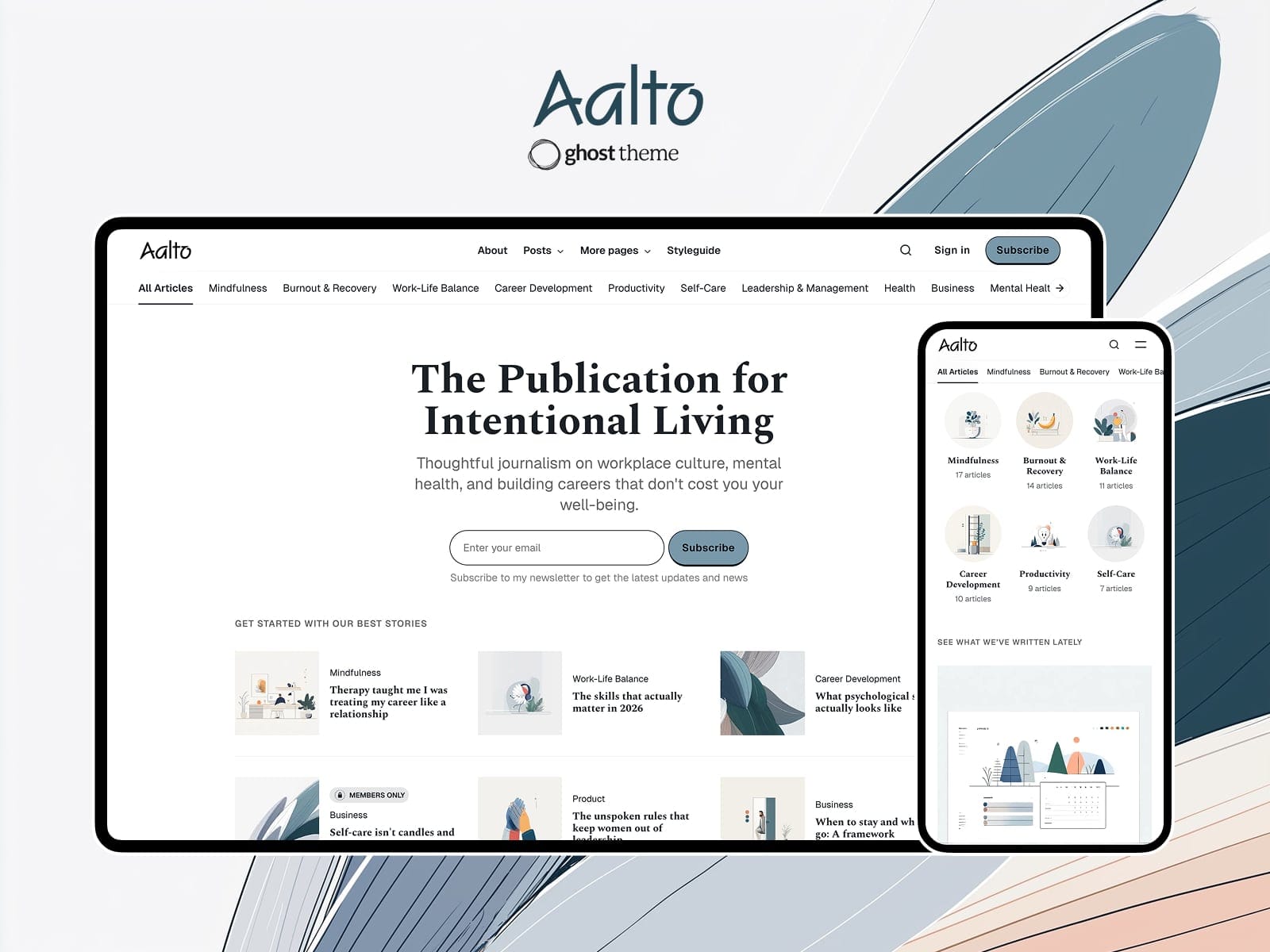
Aalto theme homepage overview
Getting started
Welcome
Aalto is built on a simple philosophy: serious content deserves serious presentation. This theme gives editorial teams the structure of a professional publication with the flexibility to make it distinctly yours. With customizable homepage sections, multiple post layouts, and extensive theme options, you have everything you need to create a trusted publication.
Quick start
Here's a quick overview of the key tasks to set up your Aalto theme:
- Upload and activate the theme
- Customize the homepage hero section
- Configure featured posts
- Add homepage sections (logos, testimonials, authors, etc.)
- Set up topics/categories navigation
- Customize colors and appearance
- Configure post settings
Install theme
Upload zip file
To begin, unzip the downloaded package by double-clicking it on a Mac or by right-clicking and selecting "Extract All" on Windows.
Inside the new Aalto folder, you will find the Aalto.zip theme file.
Step-by-step to upload the theme to your website
- Log in to your Ghost website admin (example.com/ghost).
- Click the settings icon ( ⚙️ ) at the bottom of the left-hand side.
- Go to Design & branding > Theme > Change theme.
- Click Upload theme and select the Aalto.zip theme file.
- Once uploaded, click Activate now to activate the theme.
General settings
Colors
The theme supports changing the accent color and offers different preset color combinations.
Set accent color
The accent color is the primary color used throughout your publication theme in buttons, links, and other interactive elements. You can change the theme accent color from the Ghost admin.
Change the accent color from the admin Settings > Design & branding > Customize > Brand > Accent color.
Preset color combinations
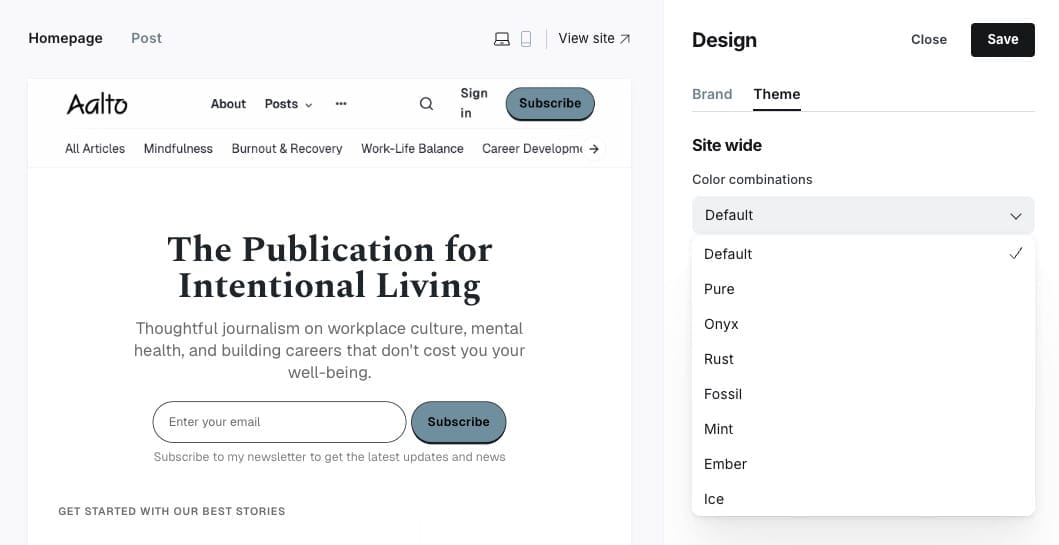
Color combination options
The theme provides 8 different color combinations. Choose the one that fits your style:
- Default - Classic and versatile color scheme
- Pure - Clean, minimalist black and white
- Onyx - Deep, sophisticated dark tones
- Rust - Warm, earthy palette
- Fossil - Natural, muted tones
- Mint - Fresh, cool greens
- Ember - Warm, energetic oranges
- Ice - Cool, crisp blues
Step-by-step to choose your preferred color combination
- Go to the admin Settings > Design & branding > Customize > Theme.
- Click on Color combinations and select your color combination.
- Preview and Save.
Light / dark mode
You can easily switch between light, dark, system, or user-defined modes directly from your Ghost admin panel.
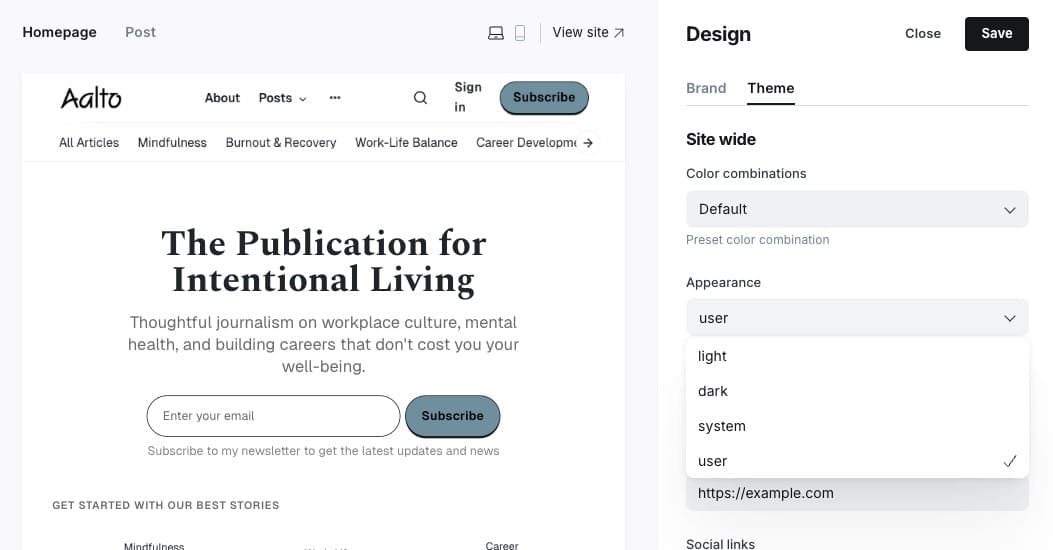
Light and dark mode settings
The theme supports:
- Light - Always display light mode
- Dark - Always display dark mode
- System - Automatically match the user's operating system preference
- User - Allow users to toggle between light and dark mode with their preference saved
Step-by-step to customize
- Go to Settings > Design & branding > Theme from the admin menu.
- Choose a preferred mode by clicking on Appearance.
- Click Save.
Note: When set to "User", a theme toggle button appears in the header allowing visitors to switch between light and dark modes. Their preference is saved locally.
Typography
Ghost provides built-in custom font functionality, allowing users to select heading and body fonts from a curated list directly in the admin interface.
Step-by-step to change fonts
- Go to Settings > Design & branding > Customize > Brand.
- Under Typography, select:
- Title font for headings
- Body font for main text
- Click Save.
Host your own fonts
You can change any font from the Ghost admin interface using Code Injection and Google Fonts, or your own font. For example, if you want to use "EB Garamond" fonts from Google Fonts, your code in Code Injection will be:
<link href="https://fonts.googleapis.com/css2?family=EB+Garamond:wght@500&family=Inter:wght@400;700&display=swap" rel="stylesheet">

<style>
  :root {
    --font-base: 'EB Garamond', serif;
  }
</style>
Header navigation
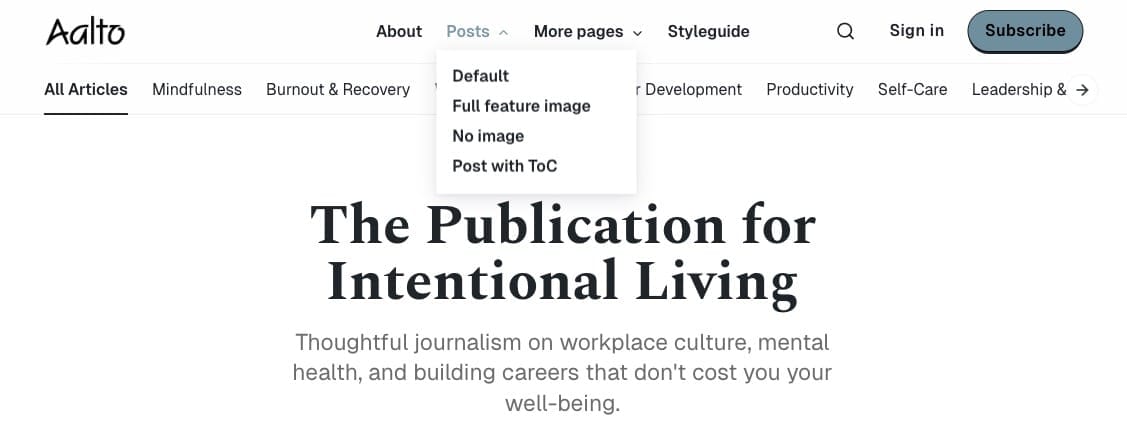
Step-by-step to add an item to header navigation
- Go to Settings > Navigation > Primary Navigation.
- Type the page's name in the label field as you'd like it to appear on your menu.
- Click on the item's URL. The blog URL will already be auto-populated.
- When satisfied with your page configurations, click the Save button.
You can create dropdown sub-menus in your Ghost site navigation to organize your content more effectively and improve site navigation.
Add dropdown menu
- In your Ghost Admin panel, go to Settings → Navigation.
- Add your main menu items normally.
- To create submenu items, add them with a dash (-) prefix before the child item.
- Arrange items in the order you want them to appear.
Example settings:
Home          /
About         /about
- Team        /team
- Contact     /contact
Blog          /blog
Header profile displays Publication logo from Settings → Design & branding → Brand → Publication logo. If no logo is uploaded, the site title will display instead.
Header call-to-action button
You can add your own CTA text and link in the header. If you leave it empty, the button will be hidden.
Header call-to-action button
- Go to Settings > Design & branding > Theme.
- Scroll to Header action text:
- Add the text to Header action text. Leave it empty if you want to hide it.
- Add link to Header action link.
- Click Save.
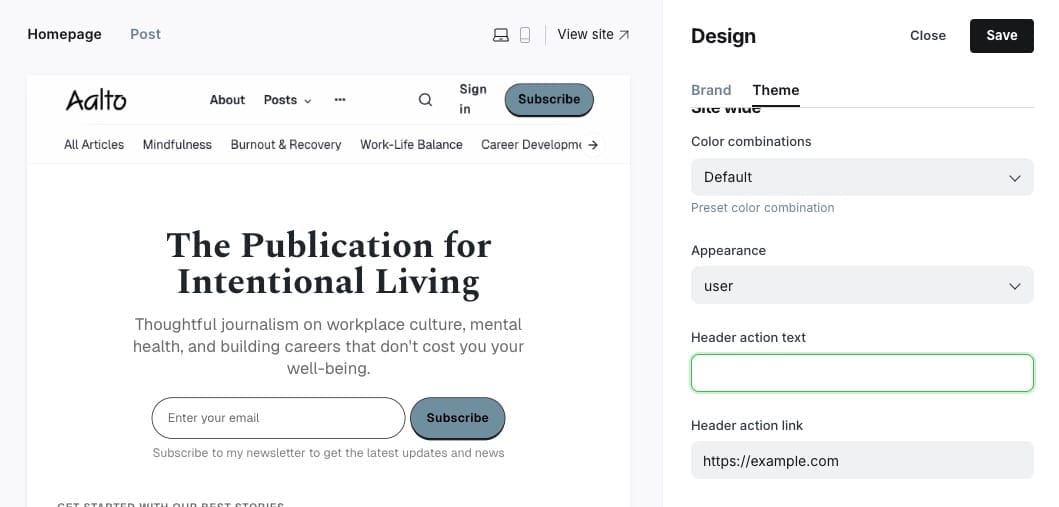
Example configurations:
- Contact button:
- Text: "Contact Us"
- Link: "/contact"
- External link:
- Text: "Get Started"
- Link: "https://example.com/start"
Category navigation
The category navigation is a horizontal scrollable bar that appears below the main header on your homepage and tag pages. It helps visitors quickly browse content by topic.
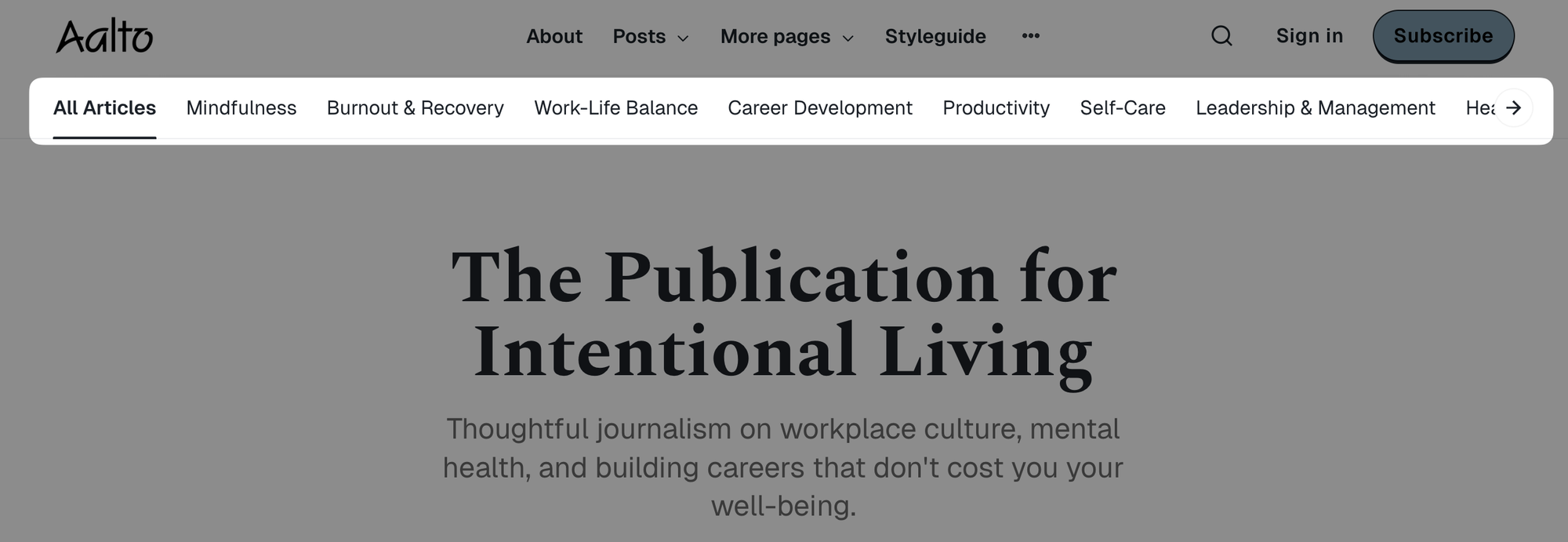
Default behavior
By default, the category navigation displays:
- An "All Articles" link to your homepage
- Up to 13 of your most popular public tags (sorted by post count)
Customizing with your own tags
You can replace the automatic popular tags with your own curated list of tags.
Step-by-step to customize category navigation
- Go to Settings > Design & branding > Customize > Theme.
- Scroll to the Homepage section.
- Find the Category navigation field.
- Enter the tag slugs you want to display, separated by commas.
- Example:
design,technology,lifestyle,tutorials
- Example:
- Click Save.
Tip: To find a tag's slug, go to Tags in Ghost admin, click on the tag, and copy the text in the Slug field.
The final settings should look like the following:
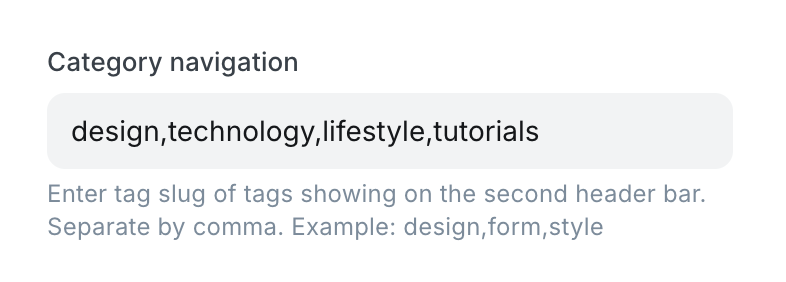
White logo on dark mode
If you use a black logo image and enable dark mode, you would need your logo visible when users enable dark mode.
You can use Code injection and insert this CSS to support different logo color on light/dark mode:
<style>
:root[data-theme=dark] .head-logo-wrap img {
    filter: invert(100%);
}
</style>
Footer navigation
Like the header, you can add the footer navigation links from the Ghost Admin Settings > Navigation > Secondary.
To group footer items into different groups, add # before the name.
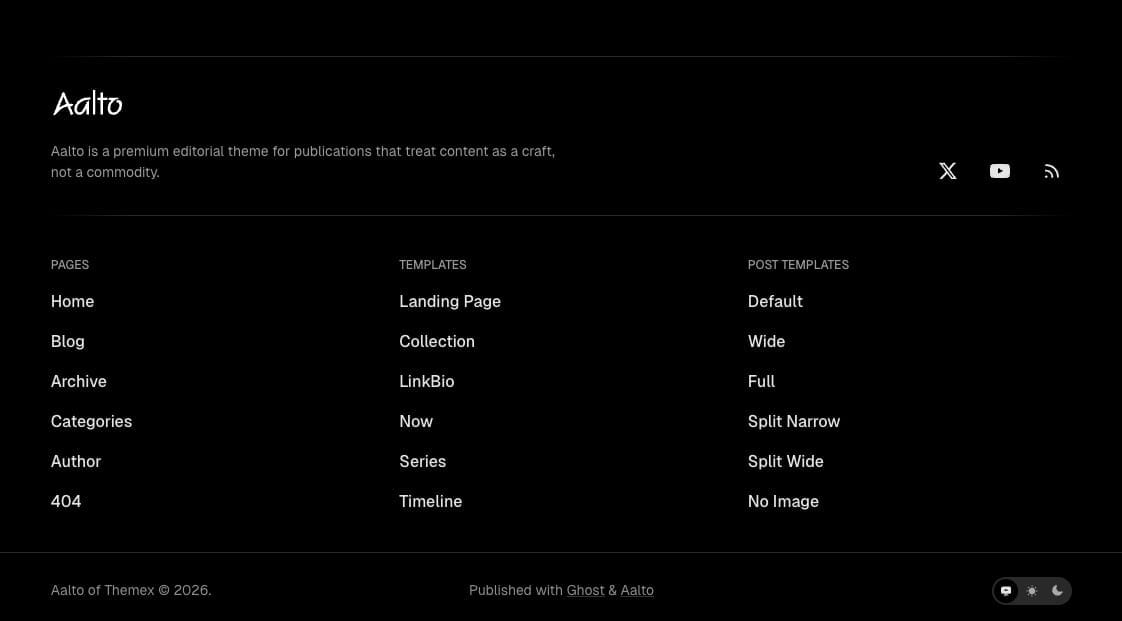
Footer navigation groups
Example configuration:
#Company
About Us      /about
Careers       /careers
#Legal
Privacy       /privacy
Terms         /terms
Social links

The Aalto theme includes a comprehensive global social links system that automatically detects and displays social media icons from URLs you provide. The social links appear in the hero section (when enabled) and in the footer.
Simply paste the full URL to your profile on any supported platform. The theme will automatically detect the platform and display the correct icon.
Supported platforms
The theme automatically recognizes and displays icons for many platforms, including:
- Social media: Instagram, Threads, Facebook, Twitter/X, LinkedIn, TikTok, Bluesky, Mastodon, Pinterest
- Professional: GitHub, Dribbble, Behance, Medium
- Media: YouTube, Vimeo, Spotify
- Communication: Email, WhatsApp, Telegram, Discord
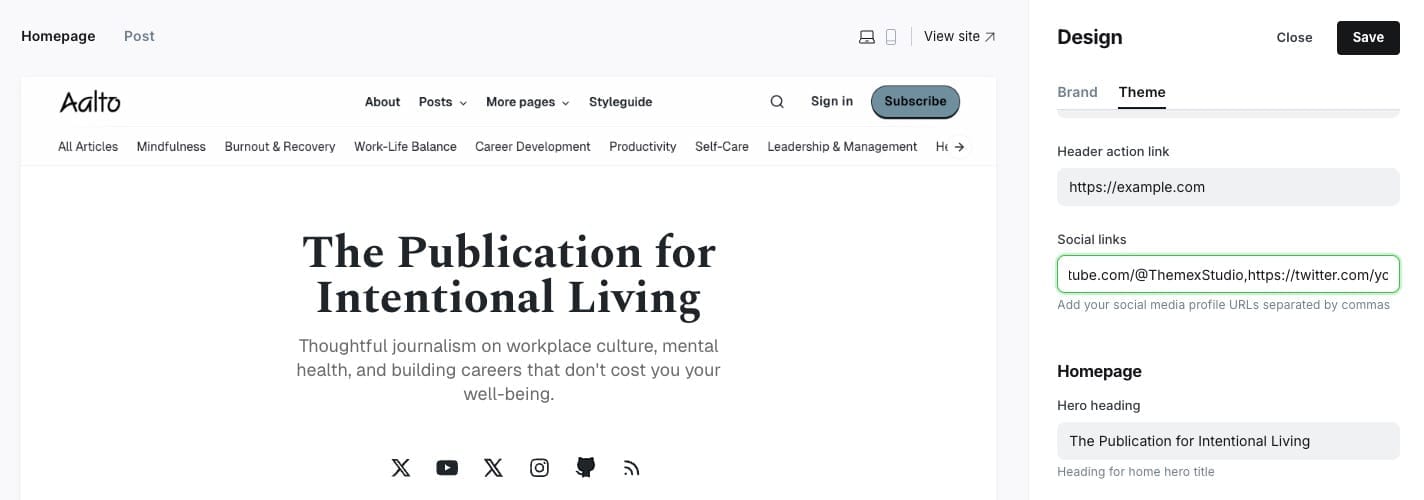
Step-by-step to add social links
- Go to Settings > Design & branding > Theme.
- Find the Social links field in the theme settings.
- Add your social media profile URLs separated by commas.
- Example:
https://twitter.com/yourusername, https://instagram.com/yourusername, https://github.com/yourusername - Click Save.
Display locations
Social links appear in two locations:
- Hero section - When you select "Social links" in the Hero actions dropdown (Settings > Theme > Homepage > Hero actions)
- Footer - Social links always appear in the footer
Adding special link types
Email links:
- Add
mailto:[email protected]or just[email protected] - The theme will automatically display an email icon
Phone links:
- Add
tel:+1234567890or just+1234567890 - The theme will automatically display a phone icon
Homepage
Homepage overview
The Aalto theme homepage is designed for flexibility and easy customization. You can build a dynamic homepage using Ghost's built-in features, managing sections directly from the Ghost admin interface—no coding required!
The homepage consists of several key sections:
- Hero section - Introduction with site title/description and optional actions
- Featured posts - Highlighted content in a grid layout
- Custom sections - Tag-based landing sections (logos, testimonials, custom posts, authors, static content)
- Topics - Category/tag-based navigation section
- Latest posts - Recent articles feed with pagination
All sections are fully customizable through the Ghost admin panel.
Hero section
The hero section is the first thing visitors see on your homepage. It displays a customizable heading and description that you can set directly in your theme settings.
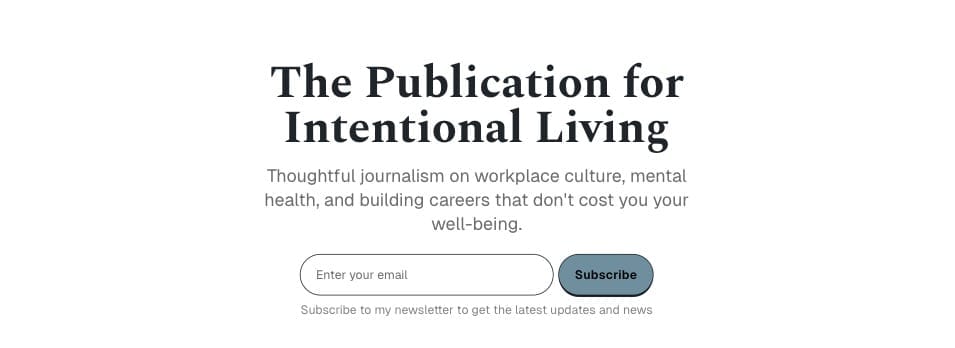
Step-by-step to customize hero content
- Go to Settings > Design & branding > Theme > Homepage.
- Find the Hero heading field and enter your main hero title.
- Find the Hero description field and enter your supporting text.
- Click Save.
Note: Both the heading and description fields support HTML formatting. You can use tags like<strong>,<em>, or<br>for text formatting if needed.
Hero actions
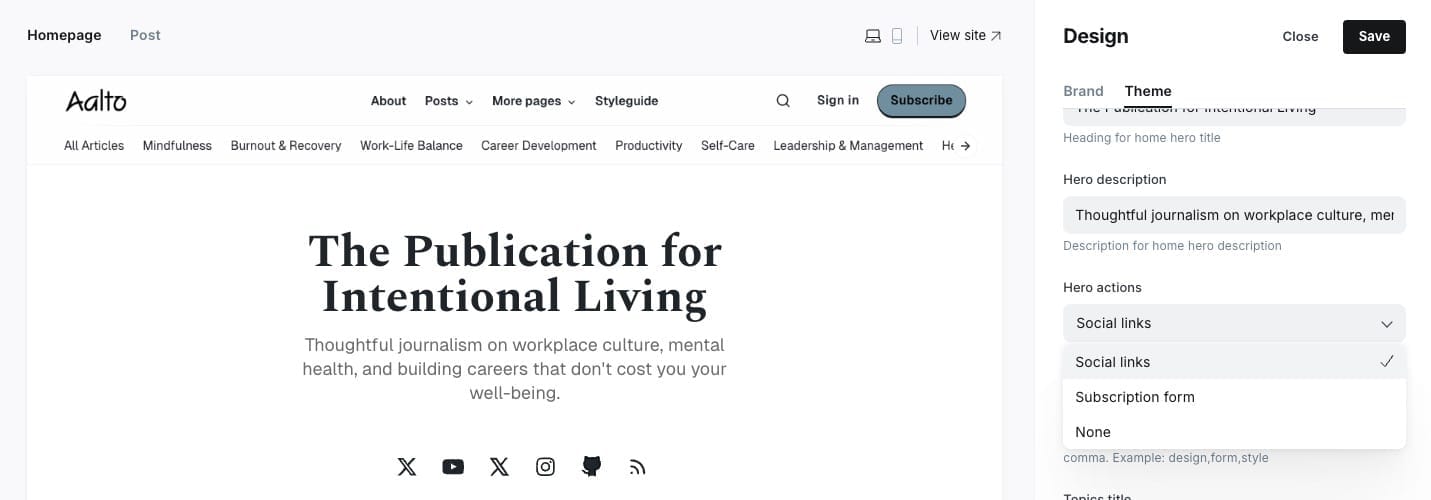
Choose to show social links, subscription box, or nothing below the hero content.
- Hero section with social links
- Hero section with subscription form
Step-by-step to set hero action
- Log in to your Ghost Admin dashboard.
- Go to Settings → Site → Design & branding → Customize.
- Go to Theme tab and find the Homepage section.
- Locate the Hero actions dropdown, select the option you want:
- Social links: Display your global social links configured in theme settings
- Subscription form: Display the subscription box
- None: No action shown
- Save and refresh the homepage.
Note: To configure which social links appear, see the Social links section in General settings.
Featured posts section
The featured posts section displays up to 6 featured posts at the top of your homepage in a 3-column grid layout.
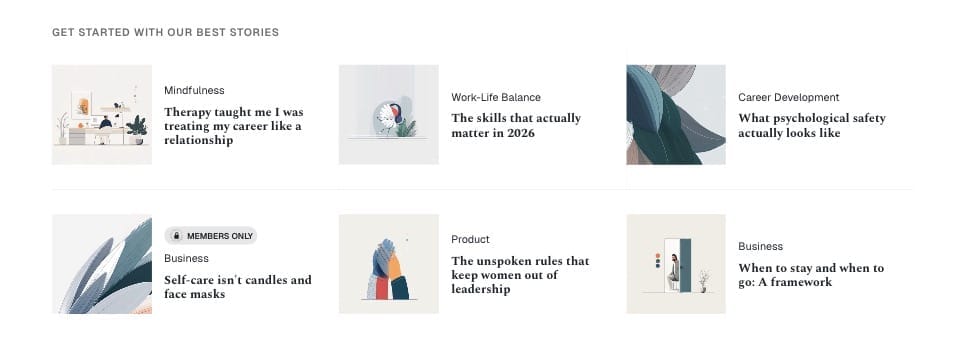
Step-by-step to configure featured posts
- Go to Settings > Design & branding > Theme > Homepage.
- Find Featured posts title and enter a title for the section (e.g., "Featured posts" or "Editor's picks").
- Click Save.
Tip: Leave the Featured posts title empty to hide this section entirely from the homepage.
How to mark a post as featured
- Go to Posts in Ghost admin.
- Click on the post you want to feature.
- Click the settings icon (⚙️) in the top right.
- Toggle Feature this post to ON.
- Update the post.
Topics section
The topics section displays a grid of tag cards, allowing visitors to explore your content by category.
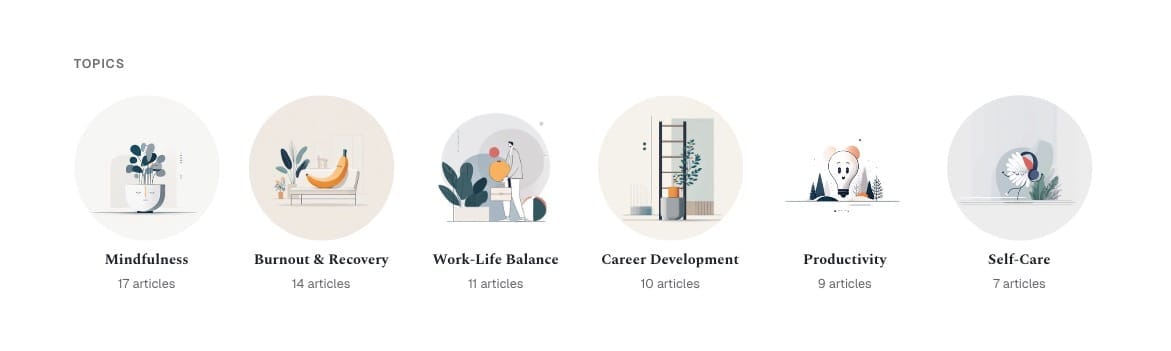
Step-by-step to set up topics section
- Go to Settings > Design & branding > Theme > Homepage.
- Find Topics title and enter a title (e.g., "Topics" or "Categories").
- Find Topics slugs and enter tag slugs separated by commas.
- Example:
design,technology,lifestyle,health - Click Save.
Tip: To find the exact tag slug, go to Tags in the Ghost admin, click on the tag name, then copy the text in the Slug field.
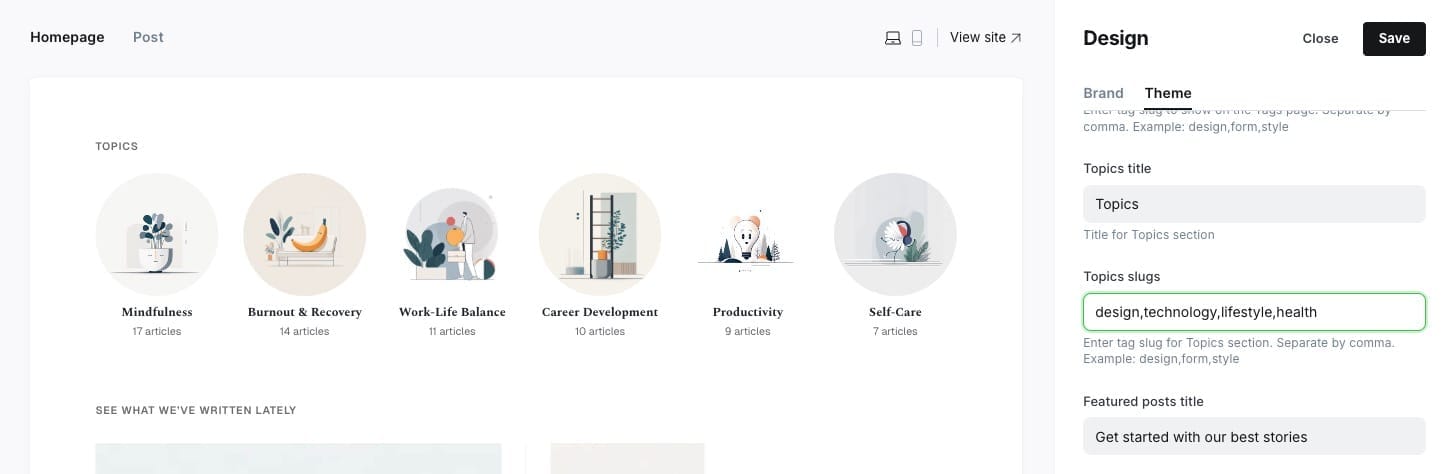
Latest posts section
The latest posts section displays your most recent blog posts in a grid layout with pagination.
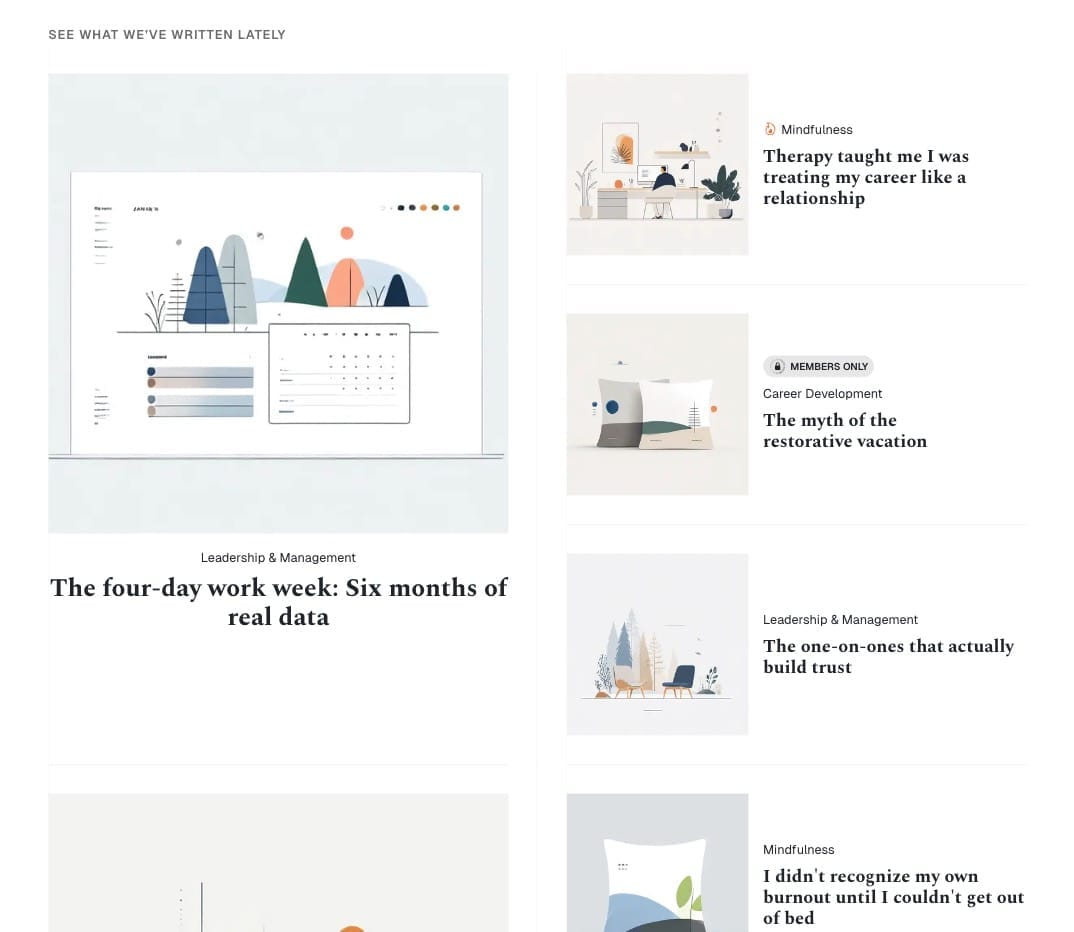
Step-by-step to customize latest posts section
- Go to Settings > Design & branding > Theme > Homepage.
- Find Home feed title and enter a title (e.g., "Latest posts" or "Recent articles").
- Click Save.
Feed image orientation
Control the aspect ratio of post card images throughout your site.
Step-by-step to set image orientation
- Go to Settings > Design & branding > Theme > Homepage.
- Find Feed image orientation.
- Select your preferred option:
- Landscape - Horizontal rectangular images
- Square - Equal width and height
- Portrait - Vertical rectangular images
- Free - Original aspect ratio maintained
- Click Save.
Note: This setting applies to post cards throughout the site, including homepage, tag pages, and related posts.
Custom homepage sections
Aalto uses a powerful tag-based section system to create dynamic homepage layouts. Each section is created as a Ghost page with a special internal tag (starting with #section-). These sections automatically appear on your homepage in the order they were published.
Key concepts:
- Sections are Ghost pages with special internal tags
- Sections appear in chronological order (by publish date)
- Use
#bottomtag to position a section at the bottom of the homepage - Use
#homepage-excludetag to hide a section from the homepage - Use
#no-titletag to hide the section title
Available section types:
| Section | Tag | Description |
|---|---|---|
| Logo wall | #section-logos |
Display partner/client logos in a marquee |
| Testimonials | #section-testimonials |
Customer testimonials and reviews |
| Authors | #section-authors |
Grid of site authors |
| Custom posts | #section-custom-posts |
Display posts filtered by tag |
| Static text | #section-static-text |
Custom text content |
| Static banner | #section-static-banner |
Full-width banner content |
| Custom content | #section-custom-content |
Raw HTML/custom content |
Logo wall section
Display partner logos, client logos, or featured brands in an auto-scrolling marquee.

Step-by-step to add logo wall section on homepage
- In the Ghost admin page, go to Pages > click on New page.
- Enter the title of the page. This title will be the section title on the homepage.
- Upload all logos you want to show on the homepage as images in the page content.
- Important: Don't add any line breaks above, between, or after the images. It will create odd alignment.
- In the Page Setting sidebar, add a tag named:
#section-logos(with#symbol). - Publish and check your homepage.
The final page content should look like the following:
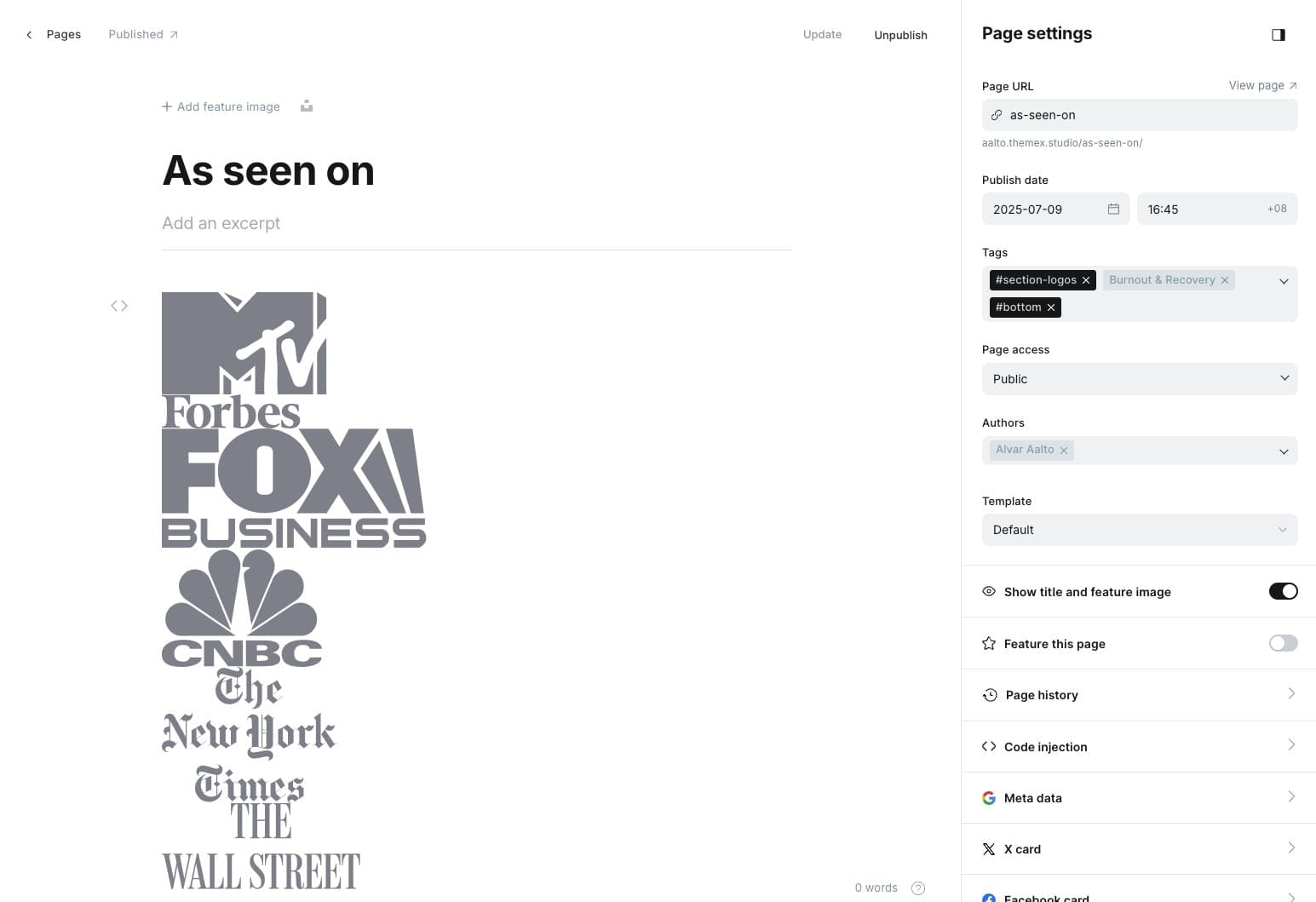
Tip: If you want to hide the section title, add #no-title tag to the page.Testimonials section
Display testimonials from your users, clients, or partners.
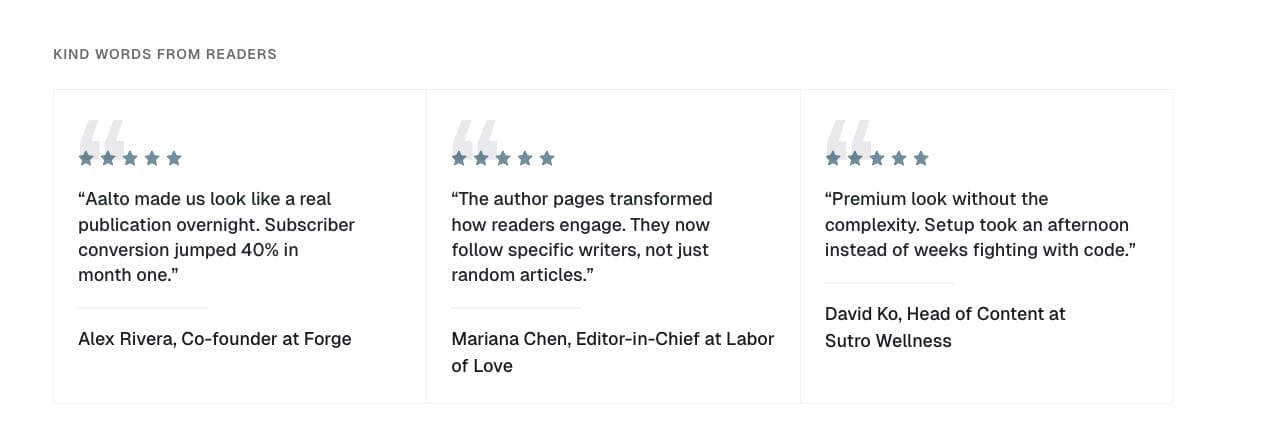
Step-by-step to add testimonial section on homepage
- In the Ghost admin page, go to Pages > click on New page.
- Enter the title of the page. This title will be the section title on the homepage.
- Add
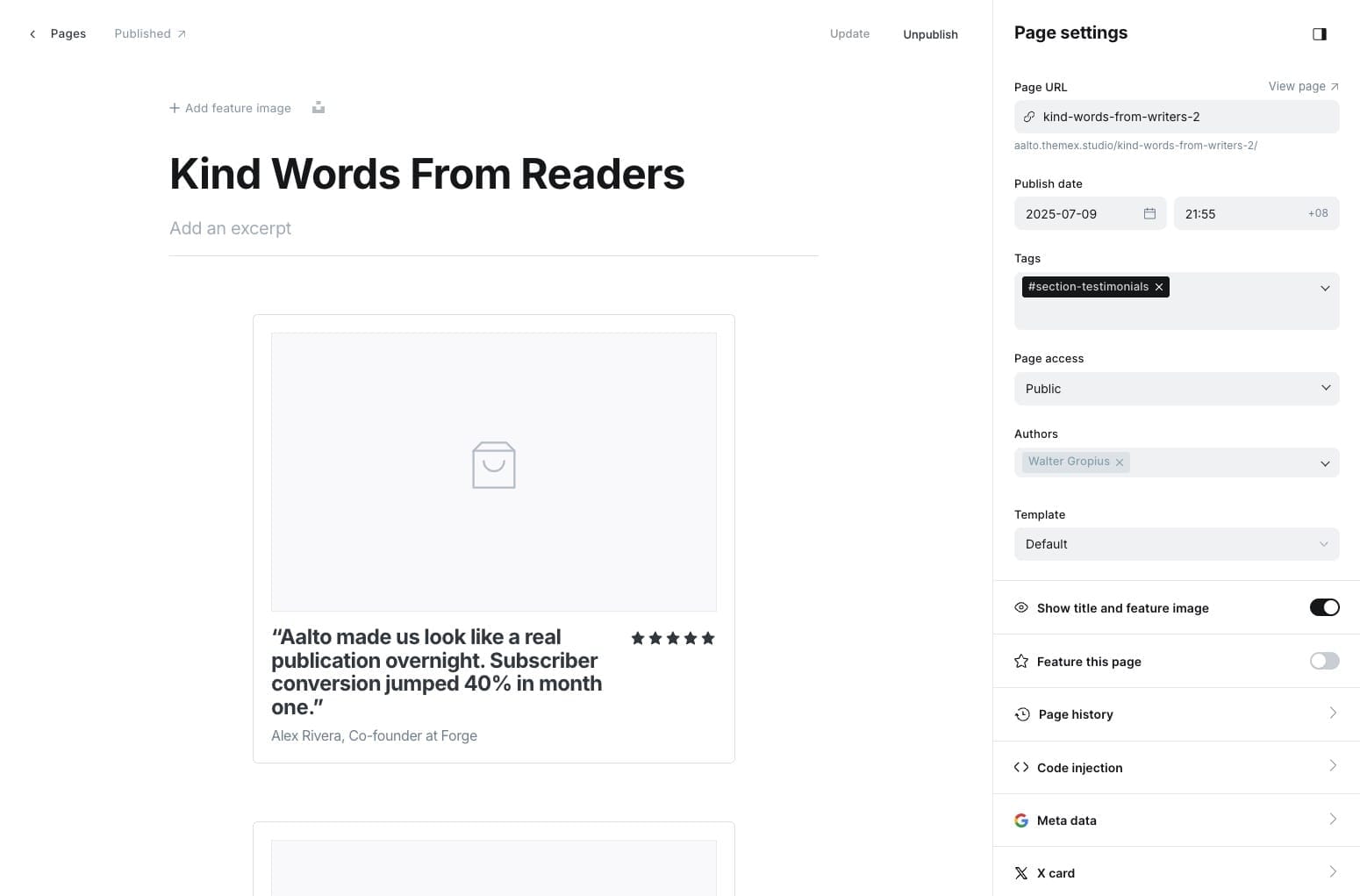
#section-testimonials(with#symbol) to the Tags field. - In the page content, add a new Product card. You can find this card by clicking on the + icon on the left side of the editor or by typing
/productin the editor, then select the Product option. - On the product card, fill in the details:
- Title - The testimonial main text (the quote)
- Description - Person's name and job title
- Image - Profile picture
- Stars - Rating (1-5 stars)
- Add more Product cards to add more testimonials.
- Publish.
The final page content should look like the following:
Authors section
Display your site's authors and contributors in a professional grid layout. Each author card shows their profile photo, name, bio, and post count.
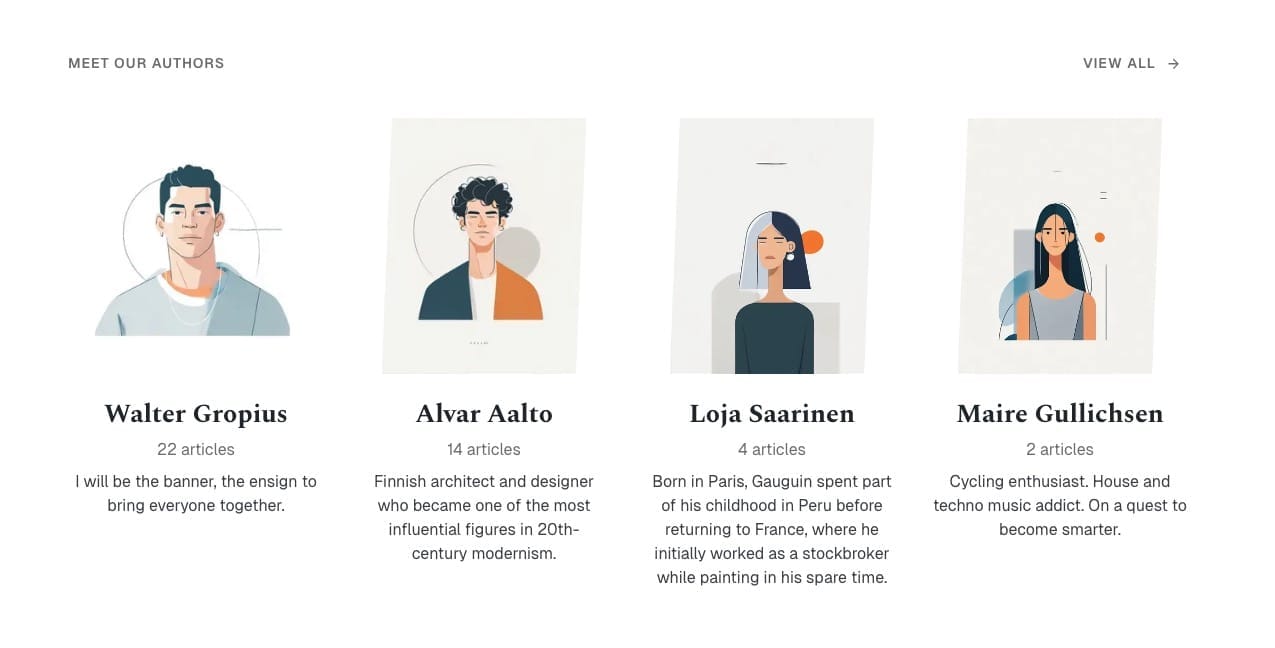
Authors section
Step-by-step to add authors section on homepage
- In Ghost admin, create a new Page.
- Give it a title; this title will be the section title on the homepage (e.g., "Our Writers" or "Contributors").
- Add
#section-authorsto the Tags input. - (Optional) To create a dedicated Authors page, select Zpage Authors in Page settings > Template.
- Publish.
The section will automatically display the top 4 authors on your site, sorted by post count (authors with the most posts appear first).
Note: If you want to hide the section title, add #no-title tag to the page.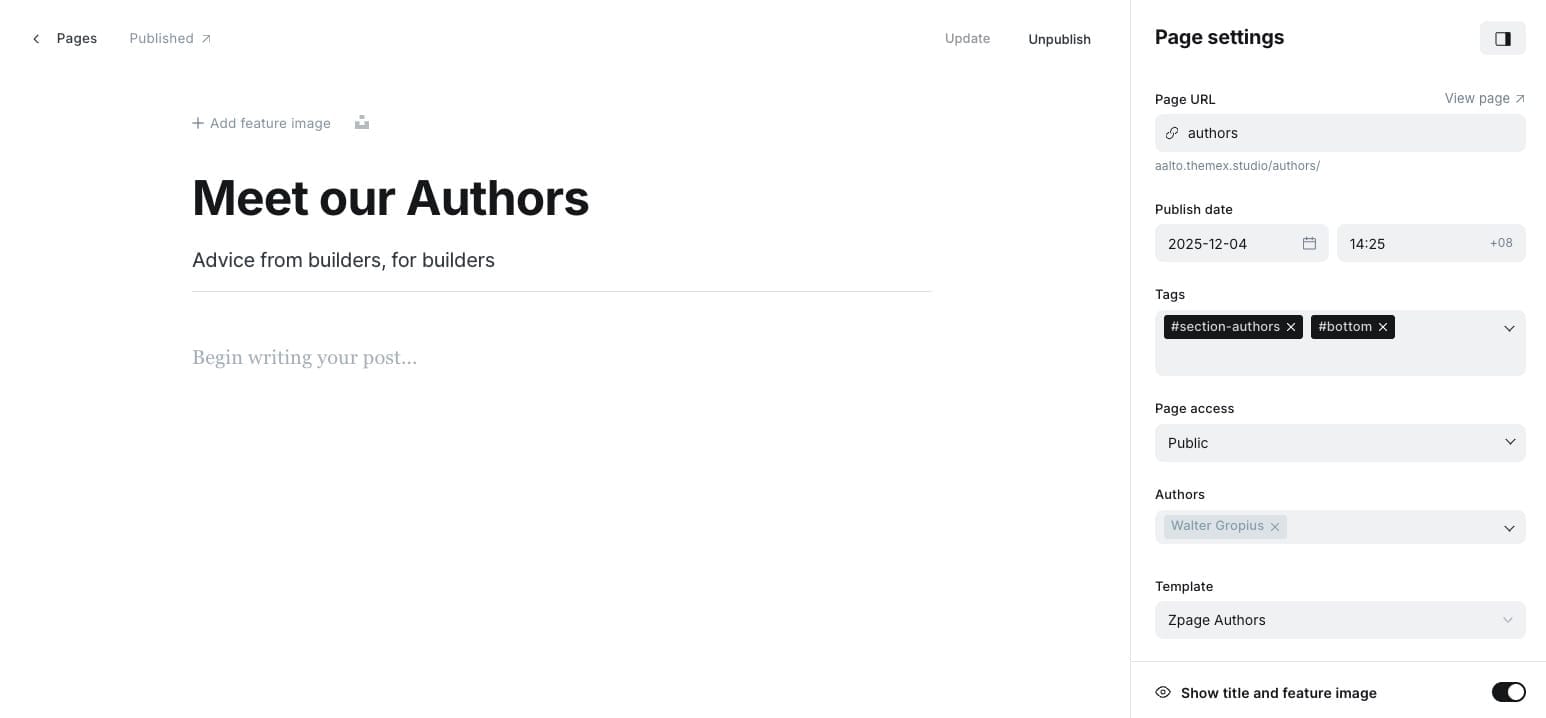
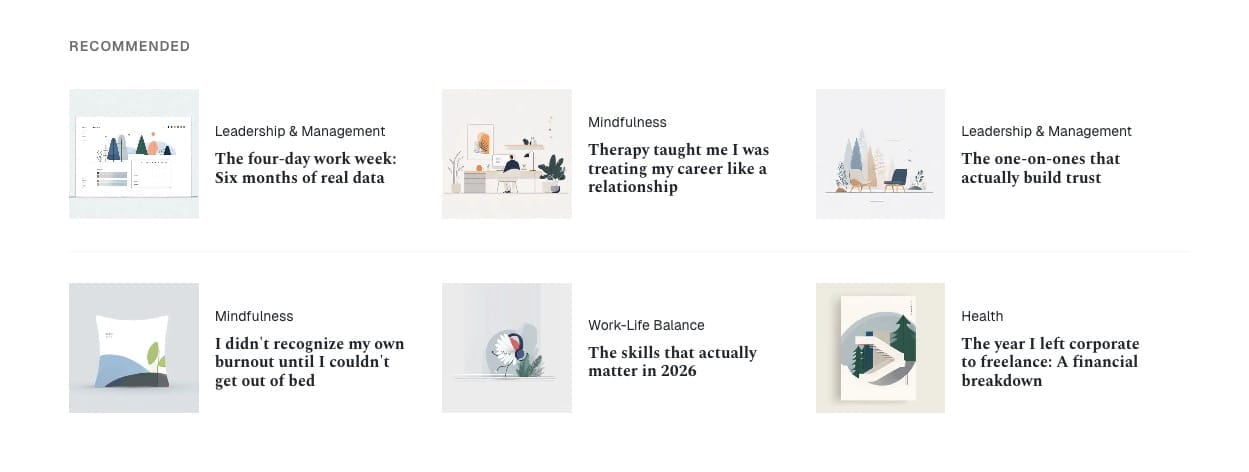
Custom posts section
Display a curated collection of posts filtered by a specific tag on your homepage.
Step-by-step to add custom posts section on homepage
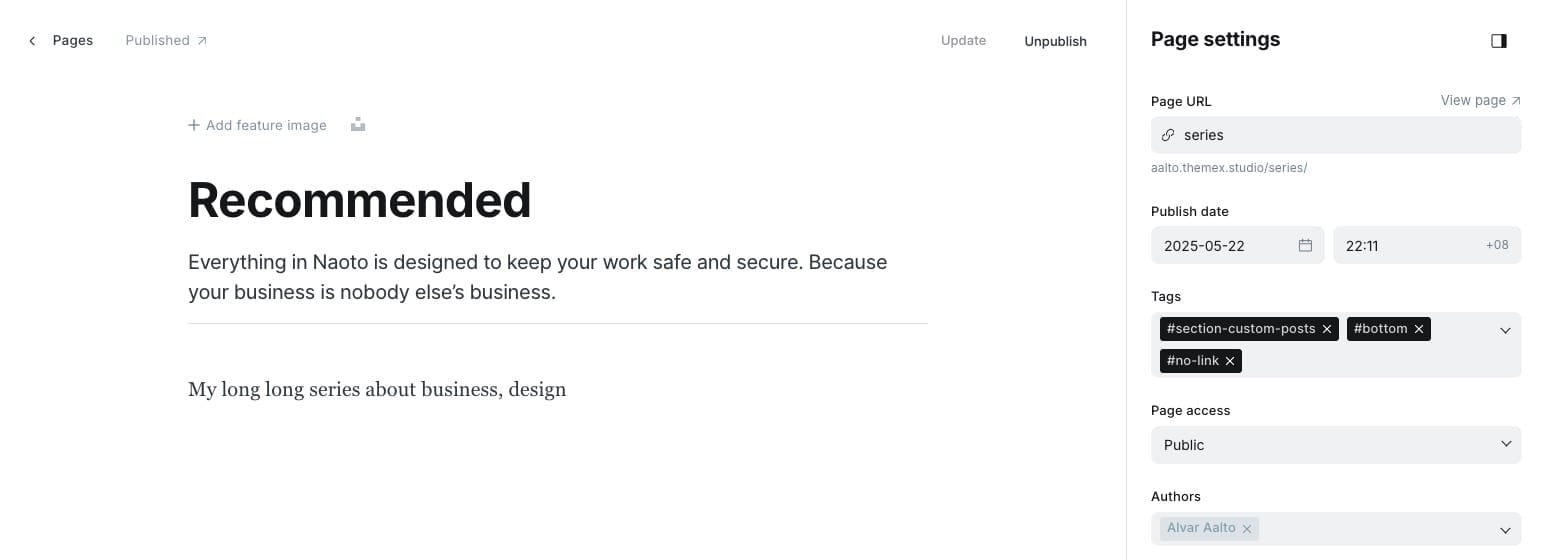
- In Ghost admin, create a new Page.
- Give it a title; this title will be the section title on the homepage.
- Add
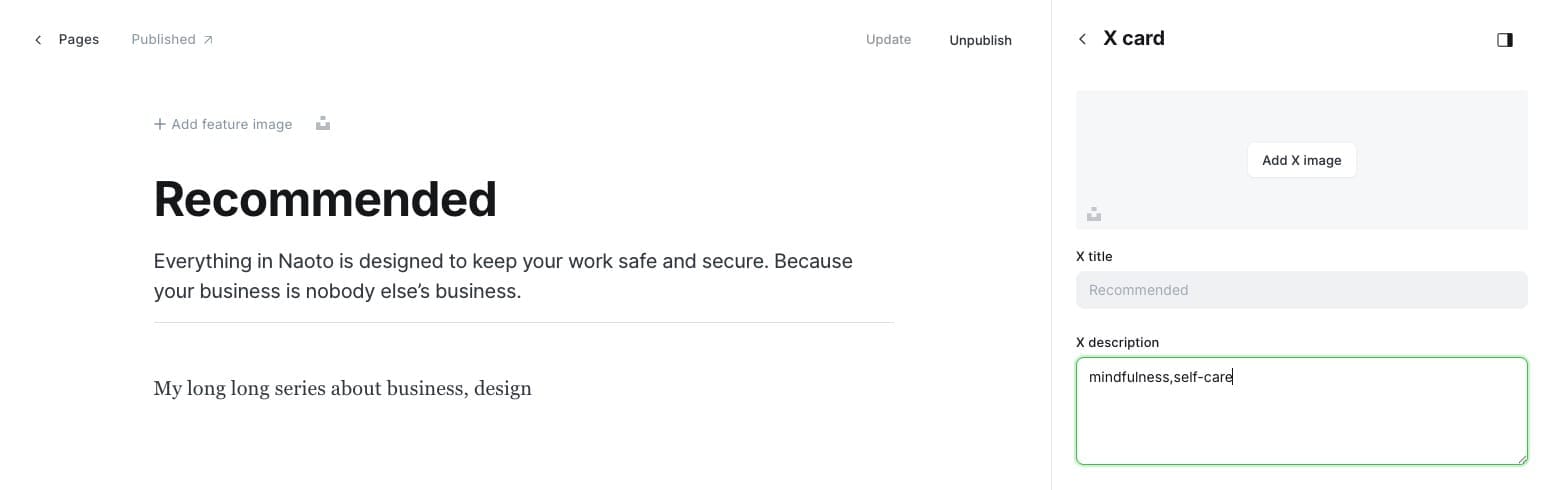
#section-custom-poststo the Tags input. - In Page settings, find the Twitter description field, enter the tag slug for posts you want to display (e.g.,
featuredoreditors-picks). - (Optional) To create a dedicated page for this content, select Zpage Collection in Page settings > Template.
- Publish.
The final page settings should look like the following:
On the homepage, the section displays up to 6 posts. On dedicated pages using the Collection template, it displays all matching posts.
Static text section
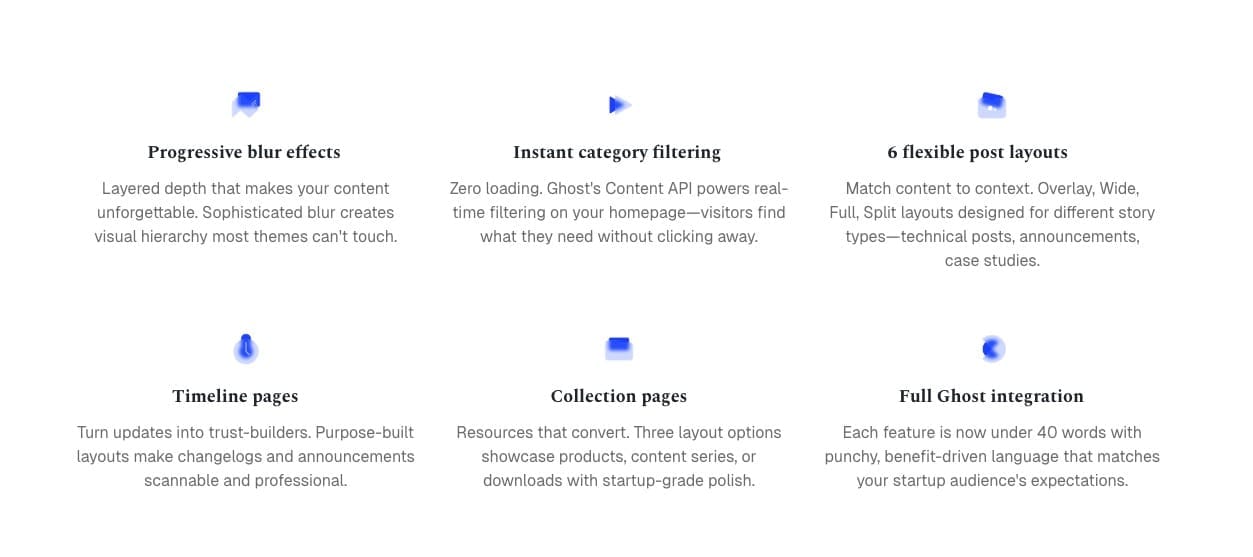
The static text section is useful for adding custom text on the homepage, such as your services, working principles, or values.
Step-by-step to add static text section on homepage
- In the Ghost admin page, go to Pages > click on New page.
- Enter the title of the page. This title will be the section title on the homepage.
- Add
#section-static-text(with#symbol) to the Tags field. - In the page content, add a new Product card. You can find this card by clicking on the + icon on the left side of the editor or by typing
/productin the editor, then select the Product option. - On the product card, fill in the title, description, image, and link (optional).
- Add more Product cards to add more static text cards.
- Publish.
Tip: If you want to hide the section title, add #no-title tag.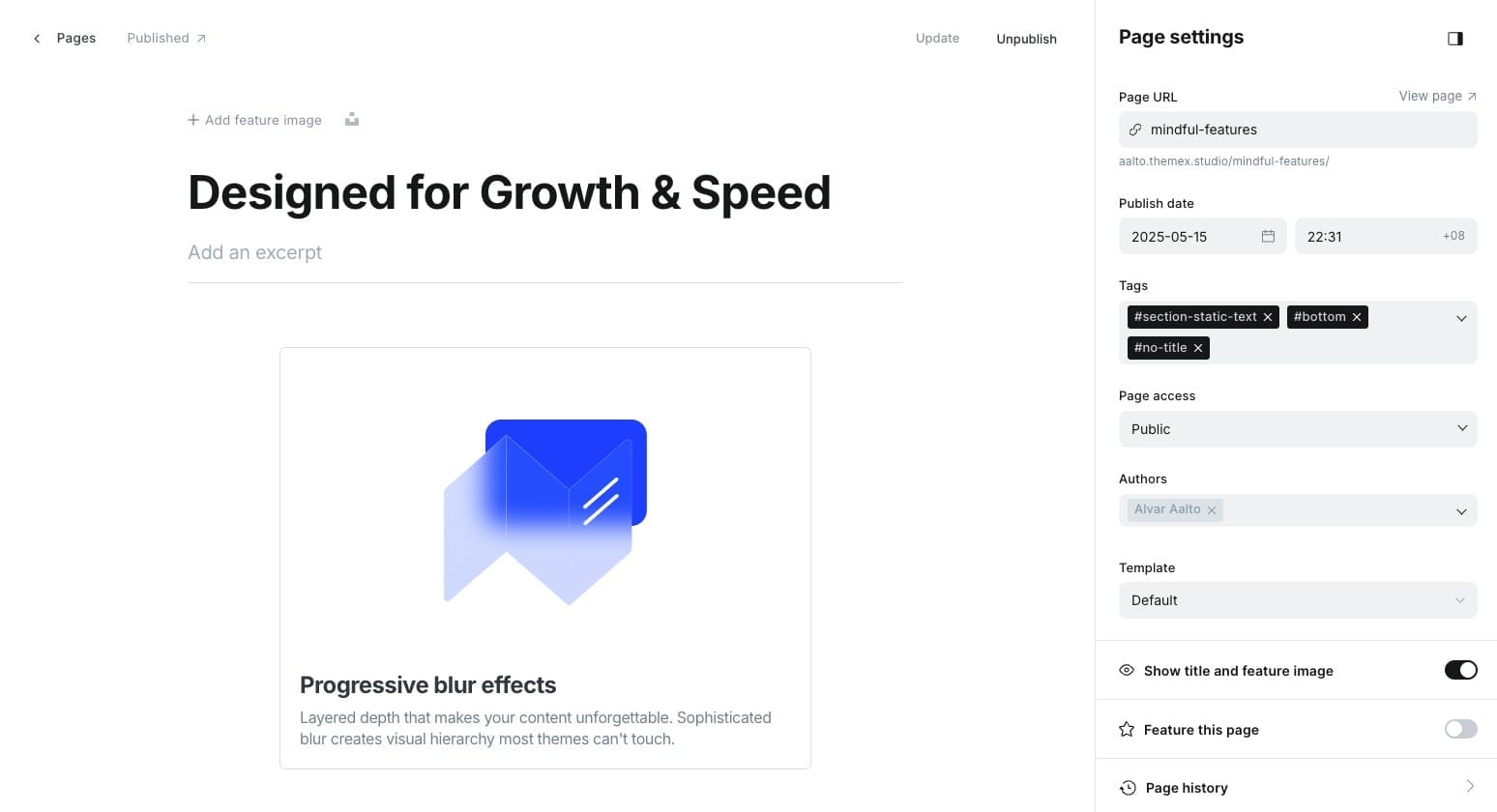
If you want to create multiple sections using Static text, create a new page and repeat the same steps above.
Static banner section
Similar to the static text section, the static banner section displays custom formatted content on the homepage. Use this for important banners, callouts, or announcements.
Step-by-step to add static banner section on homepage
- In the Ghost admin page, go to Pages > click on New page.
- Enter the title of the page. This title will be the section title on the homepage.
- Add
#section-static-bannerto the Tags field. - In the page content, add your banner content using text, images, HTML cards, or other elements.
- Add more content blocks as needed for your banner layout.
- Publish.
Tip: If you want to hide the section title, add #no-title tag.Custom content section
This section allows you to display any custom content of a specific page on the homepage. Use this for adding rich formatted content, HTML, or any special content blocks.
Step-by-step to add custom content section on homepage
- In Ghost admin, create a new Page.
- Give it a title; this title won't be shown on the homepage.
- Add your custom content in the page editor (text, images, galleries, HTML cards, etc.).
- Add
#section-custom-contentto the Tags input. - Publish.
The entire content of this page will be rendered as a section on the homepage, giving you complete flexibility to add any type of content.
Positioning sections at the bottom
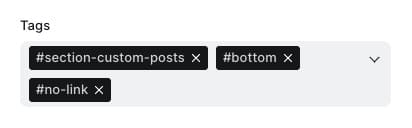
By default, homepage sections appear above the latest posts feed. To position a section at the bottom of the homepage (after the latest posts), add the #bottom tag.
Step-by-step to position section at bottom
- Create your section page as normal (e.g., with
#section-testimonials). - In the page settings, add the
#bottomtag along with your section tag. - Publish the page.
- The section will now appear at the bottom of the homepage.
Excluding sections from homepage
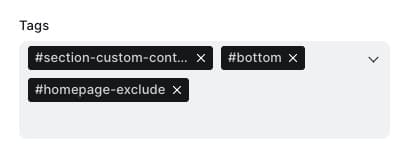
Sometimes you want to create a section page but not display it on the homepage. The #homepage-exclude tag allows you to do exactly that.
Step-by-step to exclude a section from homepage
- Create your section page as normal (e.g., with
#section-addons). - In the page settings, add the
#homepage-excludetag along with your section tag. - Publish the page.
- The section will not appear on the homepage but can be accessed via its page URL.
Hiding section titles
By default, each homepage section displays its page title as the section heading. You can hide these titles using the #no-title tag for a cleaner, more minimal look.
Step-by-step to hide section title
- Create your section page as normal.
- Add the
#no-titletag to the page (along with your section tag). - Publish the page.
- The section content will appear without the title heading.
Section background colors
Each homepage section can have a custom background color by using tag accent colors. This creates visual separation between sections.
Step-by-step to add section background color
- Go to Tags in Ghost admin.
- Find the tag you're using in your section's page.
- Click on the tag to edit it.
- Set the Accent color for that tag.
- Save the tag.
- The section on your homepage will automatically display with that background color.
Reordering sections
Sections appear on the homepage in the order they were published (oldest first). To change the order:
- Go to Pages in Ghost admin.
- Find the section page you want to reorder.
- Click the settings icon (⚙️).
- Change the Publish date to control the order.
- Earlier dates = appear first on homepage.
Post templates
The theme provides different post layout options to showcase your content in unique ways.
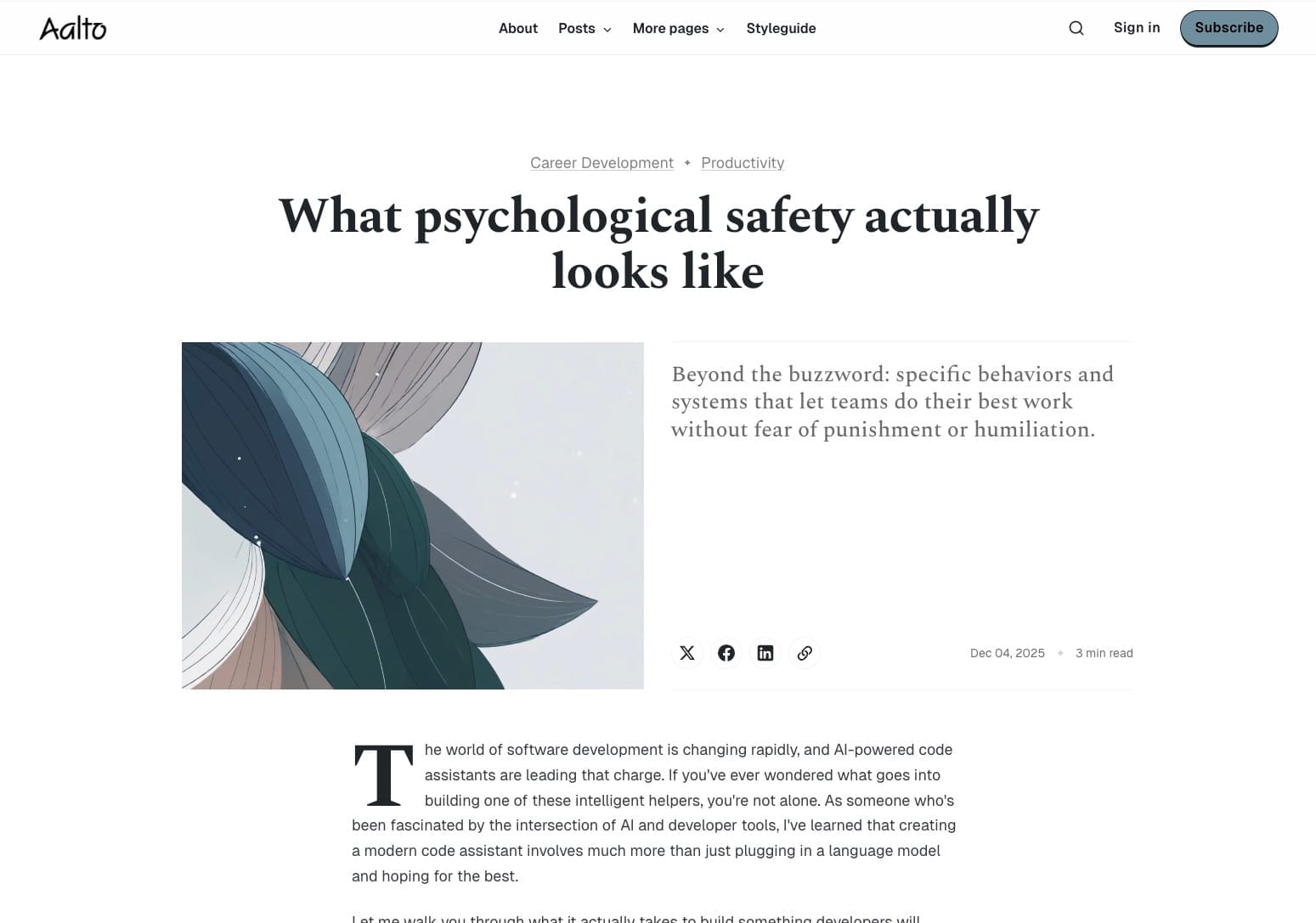
Available post templates
- Default - Standard post layout with feature image
- No feature image - Clean text-focused layout without feature image
- Wide feature image - Feature image spanning content width
- Full feature image - Feature image spanning full viewport width
Choosing layout for individual posts
To choose which template to use when you publish a specific post:
- In the post editor page, click the settings icon (⚙️) in the top right corner to open the Post settings.
- Find the Template selector and choose the style you want for your post.
- Publish or update your post.
Post page options
The theme supports additional post customizations to control what appears on post pages.
Step-by-step to customize post options
- Go to Settings > Design & branding > Theme > Post.
- Toggle options:
- Show author - Display author card with bio
- Use dropcap - Enable decorative first letter styling
- Click Save.
Table of contents
You can add a table of contents (TOC) to any post for better navigation through long-form content. The TOC automatically generates from h2 and h3 headings in your post.
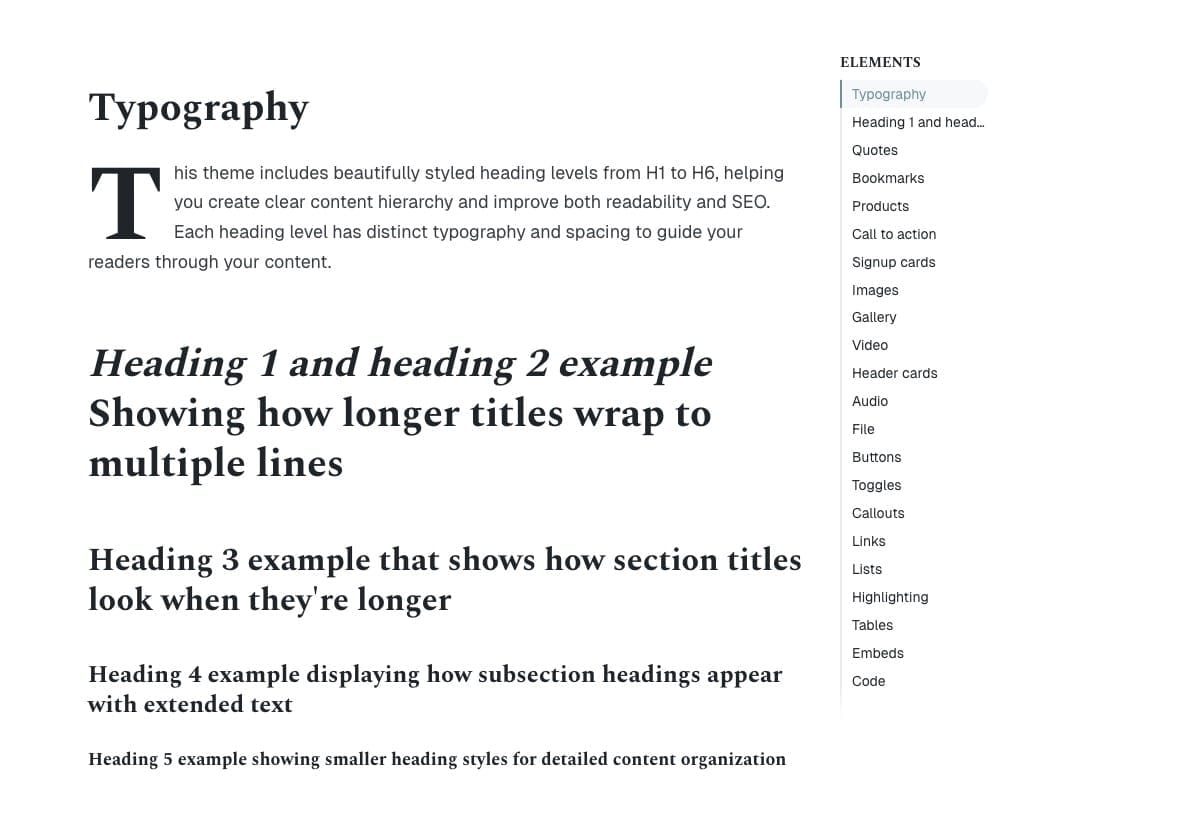
Step-by-step to add table of contents
- Create a new post and write your post using h2 and h3 headings.
- Right under the title, add an HTML card.
- Insert the following code:
<aside class="toc-container">
    <div class="toc-sidebar">
        <h4>On this page</h4>
        <div class="toc"></div>
    </div>
</aside>
- Publish and review it.
Note: The TOC will automatically populate with links to all h2 headings in your post. You can change the title "On this page" to any text you prefer.
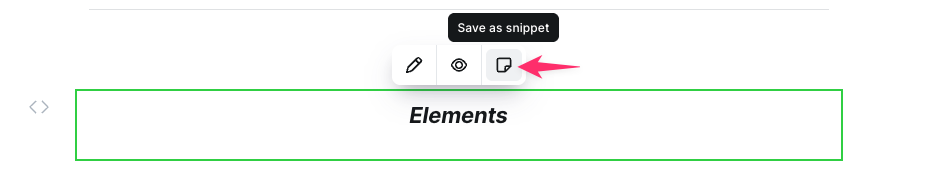
You can easily save the Table of Contents snippet and reuse it in other posts in Ghost. Simply give it a name (for example, TOC). Next time, you can simply type /TOC, and the snippet will appear, allowing you to insert it into the post to create a perfect Table of Contents.
Customizing TOC heading levels
By default, the table of contents displays only h2. If you want to show only specific heading levels (for example, show both h2 and h3 headings), you can customize this using Code Injection.
Step-by-step to customize TOC headings
- Go to Settings > Code injection in Ghost Admin
- Add the following code to the Site Header section:
<script>
window.tocbotConfig = {
    headingSelector: 'h2, h3'
};
</script>
- Modify the
headingSelectorvalue to match your needs:'h2'- Only h2 headings'h2, h3'- Both h2 and h3 headings (default)'h2, h3, h4'- h2, h3, and h4 headings
- Click Save
That's it! You only need to specify the setting you want to change. The theme will automatically merge your custom configuration with the default settings.
Note: This code must be added to the Site Header section (not Site Footer) so it loads before the theme's TOC initialization script.
Email signup text
Customize the email subscription box that appears at the bottom of posts.
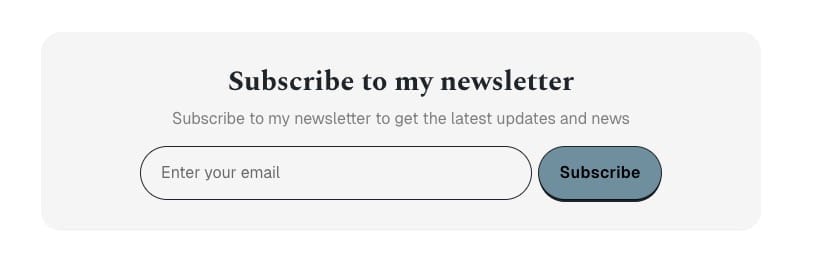
Step-by-step to customize email signup
- Go to Settings > Design & branding > Theme > Post.
- Edit the following fields:
- Email signup text - Main heading (default: "Subscribe to my newsletter")
- Email signup description - Supporting text
- Click Save.
Other templates
Individual tag pages
Each tag has its own page showing all posts with that tag.
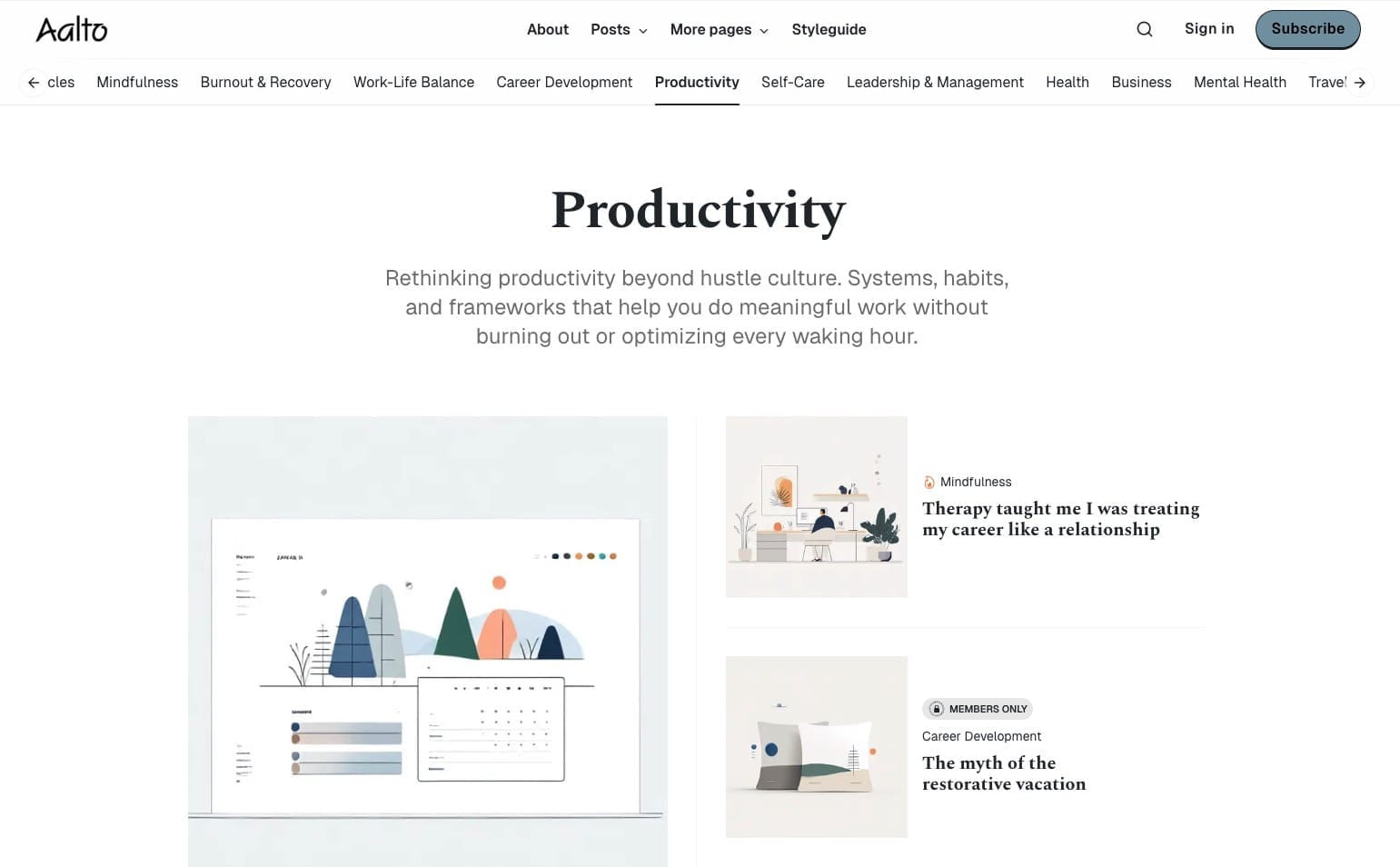
Step-by-step to customize tag information
- Go to Tags in Ghost admin.
- Click on the tag you want to edit.
- Add or edit:
- Tag name
- Tag description
- Tag image
- Accent color
- Click Save.
Authors page template
Create a dedicated page to showcase all your site's authors and contributors using the Authors page template.
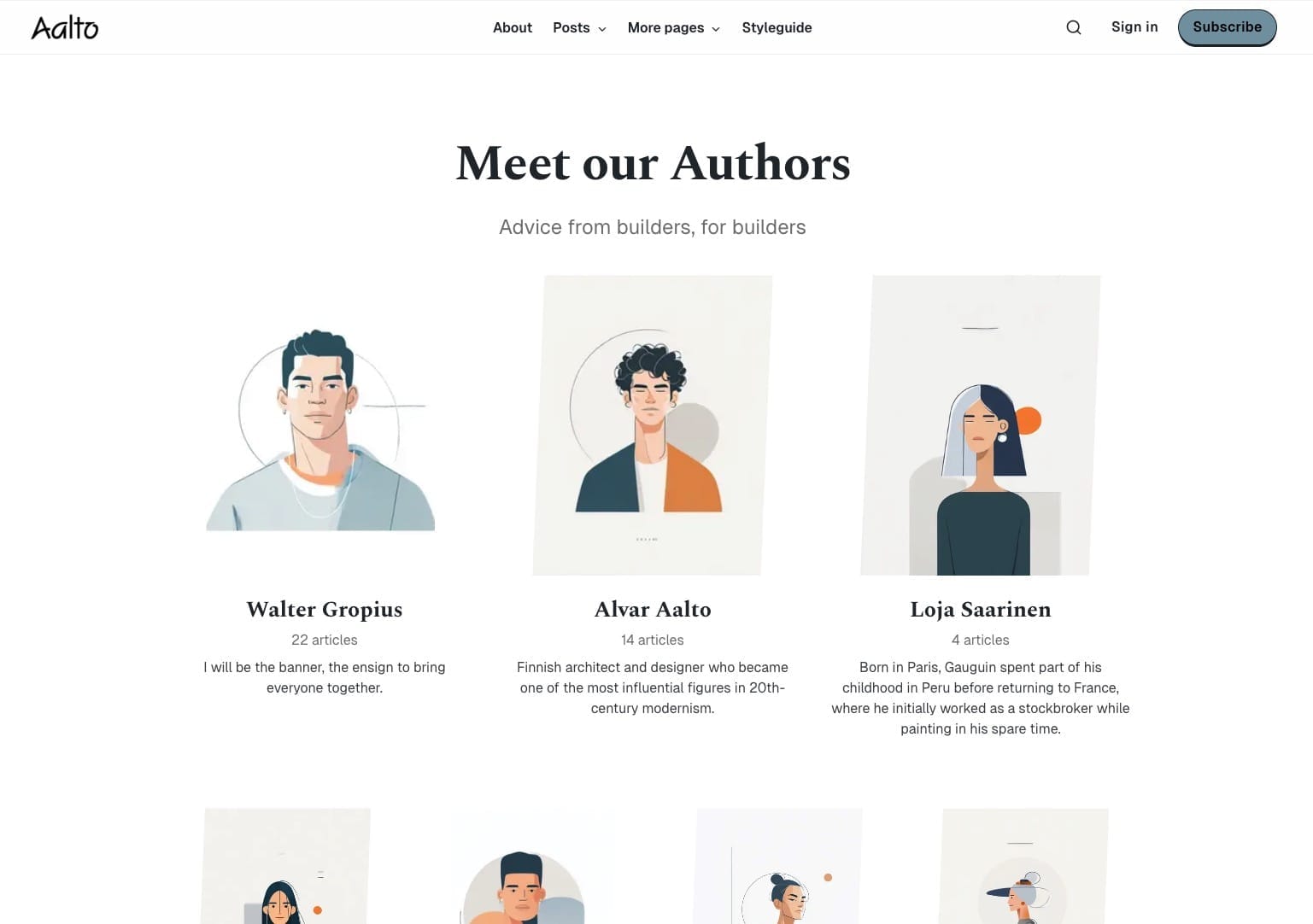
Step-by-step to create authors page
- Go to Pages in Ghost admin.
- Click New page.
- Add a title (e.g., "Our Authors" or "Contributors").
- (Optional) Add a feature image.
- In the Page settings sidebar (click the settings icon), find the Template dropdown.
- Select Zpage Authors from the template options.
- Publish.
Individual author pages
Each author has their own page showing their profile and posts.
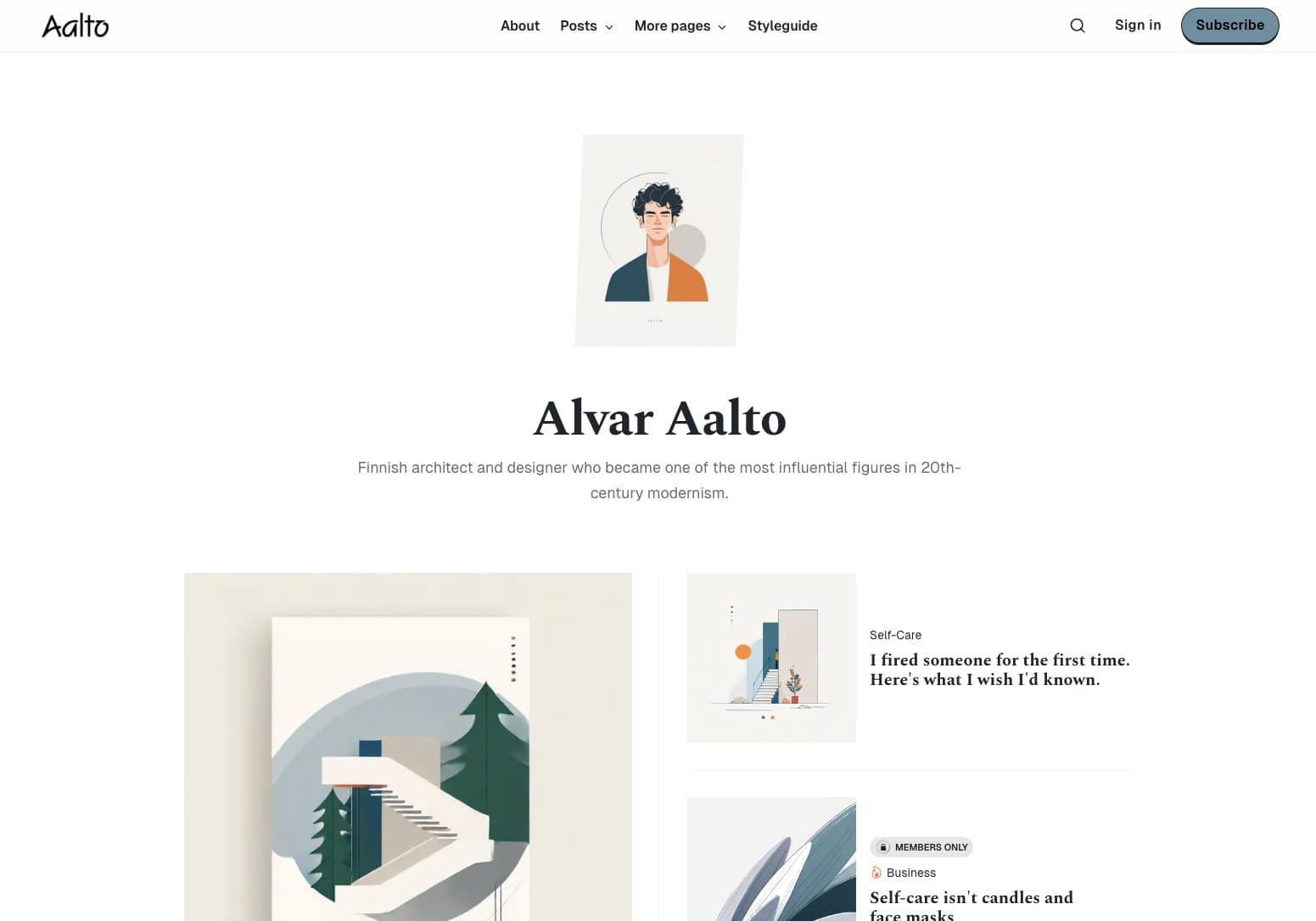
Step-by-step to customize author information
- Go to Settings > Staff in Ghost admin.
- Click on the author you want to edit.
- Add or edit:
- Profile photo
- Name
- Bio
- Location
- Website
- Social media links
- Click Save.
Collection page template
Create curated collection pages that display posts filtered by specific tags. This template is perfect for creating topic-based collections or featured content galleries.
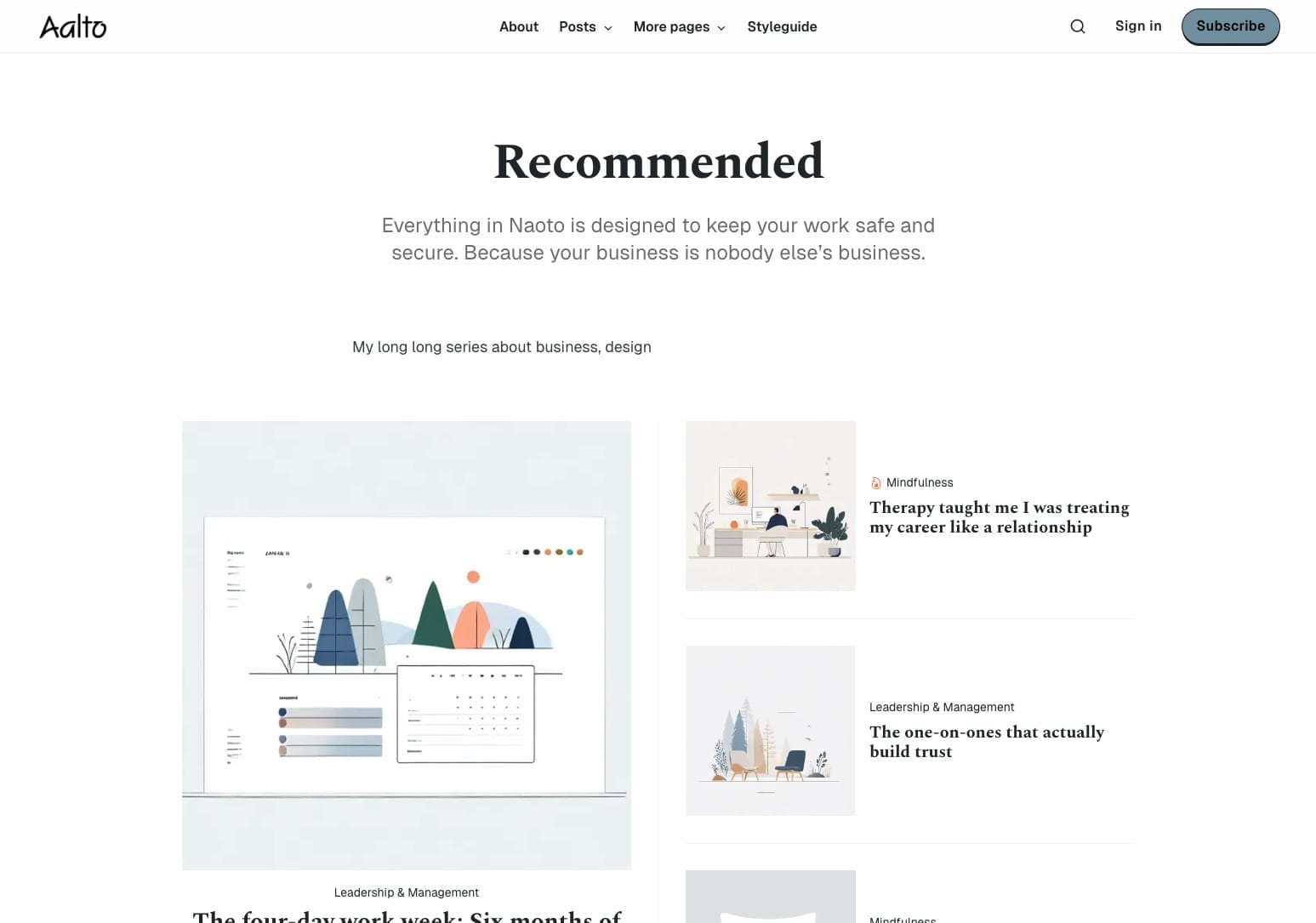
Step-by-step to create collection page
- Go to Pages in Ghost admin.
- Click New page.
- Add a title for your collection (e.g., "Featured Articles" or "Design Resources").
- (Optional) Add introductory content in the page editor—this appears above the filtered posts.
- (Optional) Add a feature image.
- In the Page settings sidebar, find the Template dropdown.
- Select Zpage Collection from the template options.
- In the Twitter description field, enter the tag slug(s) you want to filter posts by.
- Single tag:
design - Multiple tags:
design+technology
- Single tag:
- Publish.
Custom settings
Posts per page
By default, the homepage and other listing pages display a maximum of 12 posts per page, but you can change this number.
Step-by-step to change posts per page
- Download your theme from Ghost admin (Settings > Design & branding > Theme > Advanced > Download).
- Unzip the theme folder.
- Open
package.jsonin a text editor. - Find this section:
"config": {
    "posts_per_page": 12
}
- Change
12to your preferred number (e.g.,9,15,18). - Save the file.
- Re-zip the theme folder.
- Upload and activate the theme in Ghost admin.
Tip: Choose numbers that divide evenly into your grid layout. For a 3-column grid, use multiples of 3 (6, 9, 12, 15).
Google analytics
To integrate Google Analytics, I recommend using the Google Analytics integration by Ghost.
Comments
The theme comes with Ghost Native Comments integration.
Step-by-step to enable comments
- Go to Settings > Membership > Access.
- Click Edit next to your membership settings.
- Find the Commenting section.
- Choose who can comment:
- All members
- Paid members only
- Nobody (disable comments)
- Click Save.
Comments will appear at the bottom of post pages when enabled.
Syntax highlighting
You can add a fenced code block by placing triple backticks before and after the code block.
Highlighted code block
To highlight a code block, add a language alias like css or js after the opening backticks. For example:
pre {
  background-color: #f4f4f4;
  max-width: 100%;
  overflow: auto;
}
Prism.js
The theme ships with Prism.js, a lightweight, robust, and elegant syntax highlighter.
You can add support for more languages by adding the Prism autoloader script:
Step-by-step to enable autoloader
- Go to Settings > Code injection.
- Add the following script to the Site Footer section:
<script src="https://cdnjs.cloudflare.com/ajax/libs/prism/1.28.0/plugins/autoloader/prism-autoloader.min.js" integrity="sha512-fTl/qcO1VgvKtOMApX2PdZzkziyr2stM65GYPLGuYMnuMm1z2JLJG6XVU7C/mR+E7xBUqCivykuhlzfqxXBXbg==" crossorigin="anonymous" referrerpolicy="no-referrer"></script>
- Click Save.
Responsive tables
The responsive table will display a horizontal scroll bar if the screen is too small to display the full content.
Step-by-step to add responsive table
- In your post or page editor, add a Markdown card.
- Add the markdown to create a table. To generate a table, you can use the tool Markdown Tables Generator.
- Publish your post or page.
Languages
The theme is fully translatable by enabling a publication language in the settings of the Ghost Admin.
Step-by-step to add translation
- Inside the
../locales/folder, add target language files for each translatable language used on your site. For example,fr.jsonis for French, andpl.jsonis for Polish. - Translate the sentences used in the theme inside your new language files.
- Upload the theme with the new language file.
- Go to the General settings in the Ghost Admin.
- At the top of the page, you'll see the Publication info section.
- Enter the correct language code into your Publication language settings menu.
- Click Save to activate.
Note: If you edited the active language, you must restart Ghost to make the changes effective.
Advanced settings
Editing a theme's code
To edit theme files, you will need to unzip the theme archive – at this point, you will have access to the necessary files.
Step-by-step to edit theme files
- To edit your theme files, download a copy of the theme. Go to Settings > Design & branding > Theme > Advanced > Download.
- Unzip the theme locally.
- Edit files using a code editor like Visual Studio Code or Sublime Text.
- After changing the theme code, re-zip the theme directory.
- Upload the modified theme via Settings > Design & branding > Theme > Upload theme.
- Click Activate to activate the theme.
Code injection
Code injection is a powerful feature for customization without editing theme files directly.
Example: Change title color and size
- Go to Settings > Code injection.
- Add this code to the Site Header section:
<style>
  .head-logo-wrap .logo-text {
    color: #4550E5;
    font-size: 3.2rem;
  }
</style>
- Click Save.
Check out How to use Code Injection Ghost guide for more information.
Theme deploy with GitHub Actions
Aalto can be integrated with the Deploy Ghost Theme GitHub action for automatic deployment.
This allows you to:
- Edit theme files locally
- Push changes to GitHub
- Automatically deploy to your Ghost site
- Version control your theme customizations
Conclusion
Congratulations on setting up your Aalto theme! We hope this documentation has been helpful in getting you started with creating a beautiful and functional publication.
Aalto is designed to give editorial teams the infrastructure to build trusted publications with the design depth and content curation readers expect from serious journalism. With its customizable homepage sections, multiple post layouts, and extensive customization options, you have everything you need to create a professional online presence.
If you need additional support or have questions, please visit Themex Studio or consult the Ghost Help Center.
Become a subscriber receive the latest updates in your inbox.